
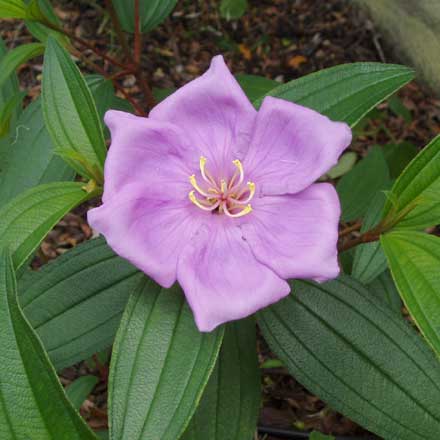
Melastoma affine, also known by the common names Blue Tongue or Native Lassiandra or as Dhumulu to the Yolngu people, is a shrub of the Melastomataceae family. Distributed in tropical and sub-tropical forests of India, South-east Asia, and Australia, it is a plant of rainforest margins. Bees are the principal pollinators of this species.
In Australia, the naturally occurring populations are in wet-sclerophyll and rainforest habitats across WA, NT, Qld and northeastern NSW. It is an important pioneer species.
It is found as a hardy fast growing evergreen shrub growing to 3 metres in height. It can be pruned to be kept smaller if required. The leaves are ovate and measure 6 to 12 cm in length, and 2-4 cm wide. Covered in fine hair they have longitudinal veins. Appearing in spring and summer, the flowers occur on the ends of branchlets and are purple with five petals and sepals. There are two sets of distinctive stamens, five opposite the petals and five opposite the sepals. The antesepalous ones have long anthers with a bilobed appendage at their base. The common name “blue tongue” refers to the edible sweet, purplish-black pulp within the fruit capsules which stains the mouth blue.
Melastoma affine is found from India through southeast Asia, Malaysia, Indonesia and into Australia. Within Australia, it is found from the Kimberleys in Western Australia, across the Northern Territory and Queensland, and reaches as far south as Kempsey on the New South Wales mid-north coast. It grows in wet areas in sclerophyll forest.
It produces no nectar – giving pollinators large amounts of pollen instead, which must be extracted through pores on the anthers. Melastoma affine is pollinated by bees, particularly Xylocopa bombylans, X. aff. gressittii, Amegilla anomola, and Nomia species. It also attracts hoverflies and other pollen-loving critters. It is a fast-growing and adaptable shrub. This plant is continually in flower throughout Spring and Summer, producing showy mauve to purple flowers that last just a few days before small black berries begin to appear. The fruit is best eaten fresh straight from the plant. It provides a fun and messy novelty for everyone.
This hardy evergreen prefers part shade and will need protection from hot winds and hot afternoon sun in the Summer. Ensure a rich, moist soil that drains freely. With its leathery, dark green foliage and contrasting red stems, this shrub is the perfect addition to an ornamental garden.


